Latvian companies are increasingly taking the next step in their digital development, and the results of the Digital Accelerator of Latvia clearly demonstrate this in numbers.
The European Union co-financed project “Digital Accelerator of Latvia (DAoL)” has become a significant support instrument for business digitalisation in Latvia. Several key indicators have already exceeded the initially set targets, demonstrating strong demand and tangible impact.
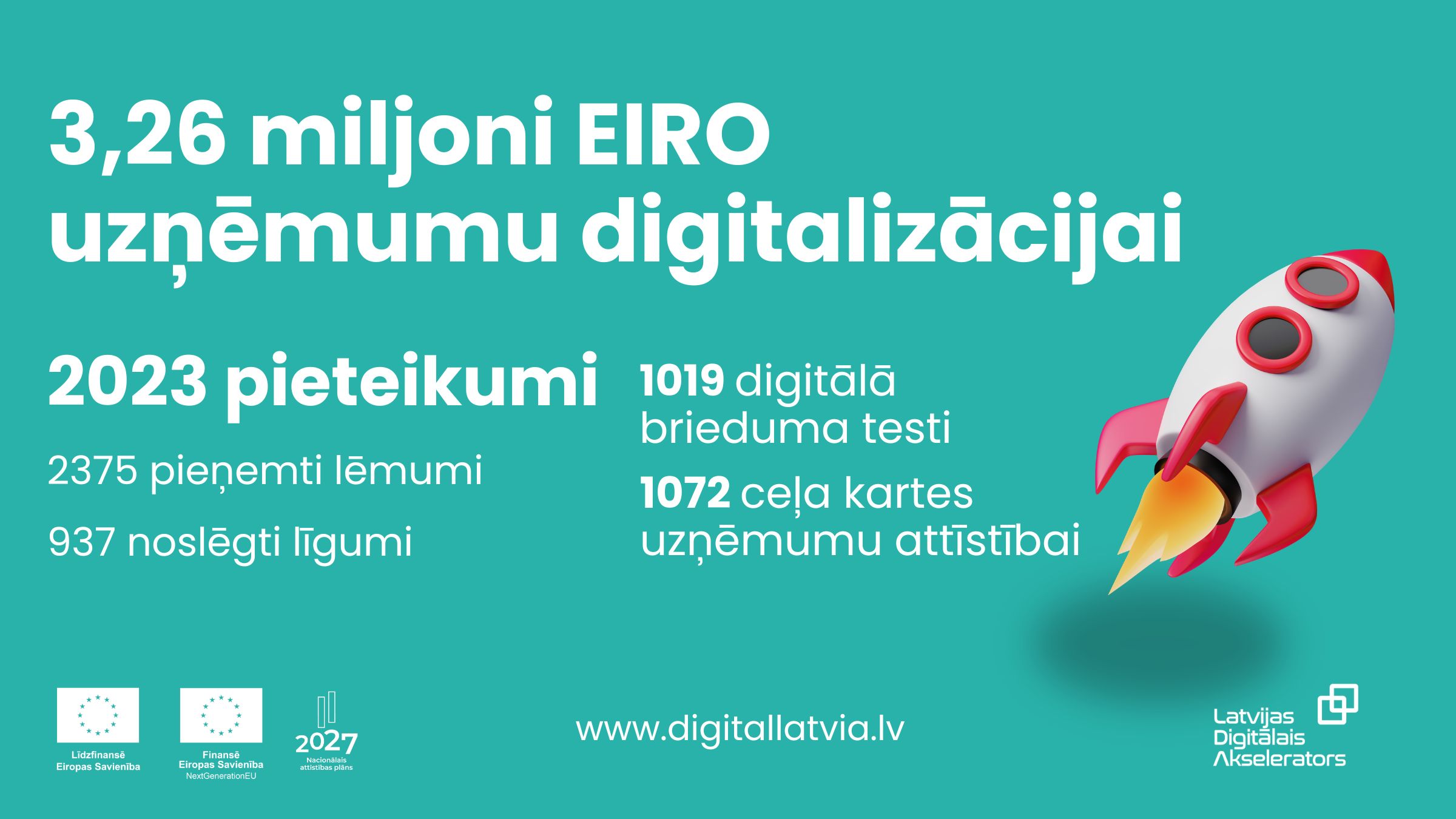
As of 25 February 2026, 2,023 applications have been received, 2,375 decisions have been made, and 937 support agreements have been concluded. This confirms that companies are actively using the opportunity to systematically assess their digital needs and receive professional support.
In the field of Digital Maturity Assessment, 851 tests have been conducted – for 720 companies and 131 representatives of the public sector. In addition, 315 repeat assessments have been carried out, indicating a long-term approach and a willingness to measure progress rather than merely initiate change.
Based on these assessments, 1,072 digital transformation roadmaps have been issued. Of these, 663 were developed for Digital Accelerator of Latvia services, while 342 roadmaps are specifically focused on digital skills development, strengthening company team competencies and readiness to work with new technologies. Additional roadmaps have also been developed in cooperation with LIAA, ALTUM and competence centres.
The economic impact is particularly significant. As a result of the project, EUR 3.26 million in investments has been attracted for company digitalisation. A total of 79 supports of up to EUR 20,000 per service have been granted for experimentation, piloting and testing, giving companies the opportunity to safely test new technologies before making larger investments.
Survey data also confirm practical impact on company performance. More than 70% of companies report profit growth or positive dynamics after implementing digital solutions, while approximately half have already achieved or partially achieved a positive return on investment. Nearly 60% of companies have reduced administrative workload by at least six hours per month, and in some cases the time savings exceed 20 hours. More than half of companies are attracting new customers using digital tools, and some have already increased employee salaries as a result of productivity gains.
These results show that digitalisation in Latvia is no longer just a concept or a future plan — it is becoming concrete action with measurable returns.
The Digital Accelerator of Latvia demonstrates that structured support, expert involvement and practical tools help companies move from idea to implementation, and from testing to growth.
For companies that are still considering digitalisation opportunities, these figures send a clear signal: transformation is happening, and support is available.
Co-financed by the European Union project “Digital Accelerator of Latvia” (DAoL), ID No. 101083718 and the European Union Recovery and Resilience Facility, ID No. 2.2.1.1.i.0/1/23/I/CFLA/002.
Funded by the European Union and the European Union – NextGenerationEU. However, the views and opinions expressed are those of the author(s) only and do not necessarily reflect the views and opinions of the European Union or the European Commission. Neither the European Union nor the European Commission can be held responsible for them.
.svg)